
Designing research posters for onsite impact, online continuity, and open-science connection
In short: Posters are often one of the largest research communication investments an organization makes for an event – and one of the least reused afterward. This paper makes the case for designing posters as layered, interactive, strategic assets that work quickly in the poster area and remain useful, discoverable, and connected to the community long after the event ends, including as companions to preprints and journal articles.
The value of an event can be more than just the event dates
Scientific and R&D events are built around a familiar premise: bring a community together in one place, for a limited time, to share new work and renew relationships. That concentrated energy is valuable and hard to replicate.
But the value of an event should not be limited to the dates on the calendar.
For many organizations, posters represent one of the largest bodies of research communication produced for an event. They require weeks of effort from authors and teams: selecting results, designing figures, tightening the narrative, rehearsing the explanation, and fielding questions. Yet at many events, posters still follow a “single-use” lifecycle: presented briefly, then rolled up, discarded, or reduced to a static PDF that is technically “available” but rarely revisited.
This is not a poster problem. It is a lifecycle problem.
The opportunity is to treat posters as strategic assets: designed to deliver immediate value onsite while remaining useful, discoverable, and connected to the community long after the event ends.
The hidden inefficiency of “single-use” posters
Poster sessions work because they do two things exceptionally well.
First, they force clarity. Posters require authors to reduce complexity into a communicable story – what they did, what they found, and why it matters.
Second, they create a social interface. Posters make it easy to approach someone, ask a question, and discover shared interests. In healthy communities, poster sessions are among the most efficient “collision engines” an event can offer.
The inefficiency appears when we look at the time horizon.
A poster may represent weeks of intellectual and design effort. But its practical impact is often compressed into a small number of hours, shaped by the realities of poster areas: crowded aisles, limited time, competing sessions, noise, and the randomness of who happens to pass by.
Then the event ends, and the poster ends with it.
Even when organizers collect PDFs, the result is usually a static endpoint: hard to explore on personal devices, difficult to navigate, and disconnected from a clear pathway for follow-up engagement. The organization invests heavily in research communication – and then lets much of that value evaporate.
A better model: design posters for two jobs, without creating two posters
A more productive way to think about posters is not as disposable event materials, but as research communication assets designed to do two jobs in a single, unified format.
At the event, a poster is a social interface. It needs to work at speed: clear at a glance, legible in a crowded poster area, and easy to use as the basis for a conversation. The goal is not exhaustive detail – it is fast understanding, relevance filtering, and live networking.
After the session, the same poster should continue as a research companion. Additional depth becomes especially valuable at this stage, when attendees have time to revisit the work, share it with colleagues, contact the authors, and return with better questions.
The key point is that this does not require two separate deliverables. The poster can stay concise on the surface while offering depth through a layered structure – clear enough to spark conversation onsite, rich enough to keep the research working online long after the event ends.
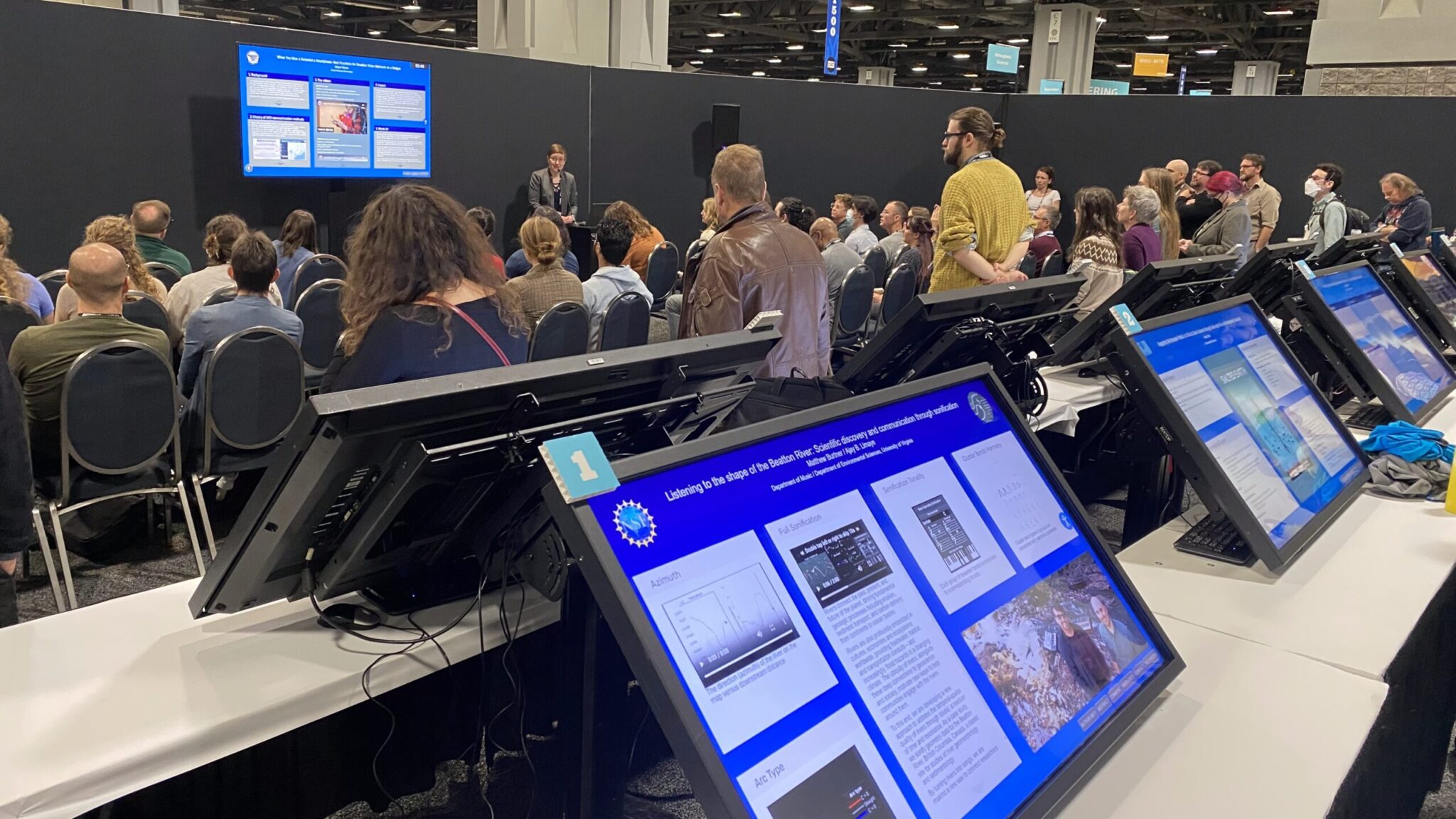
Interactive iPosters make this dual-purpose model practical. Onsite, attendees can scan, scroll, expand, zoom, and explore content according to their level of interest, expertise, and available time. Online, the same structure supports deeper and more deliberate engagement. The event retains its concentrated energy, while the research communication created for it no longer expires when the event ends.
Layering depth without clutter
The practical challenge is that a poster has to serve different levels of interest at the same time.
Some attendees need only a quick orientation: the headline result, the core visual, and enough context to decide whether to start a conversation. Others need more depth – a collaborator evaluating a method, a reviewer assessing rigor, a funder looking for context, or a researcher from an adjacent field trying to understand the work – before reading a full manuscript.
A static poster or PDF has to put all of that on one surface. An interactive poster can separate the surface from the depth.
The top layer remains clean and readable, optimized for onsite viewing and fast comprehension. Supporting material can sit behind that surface: expanded methods, supplementary figures, detailed tables, additional experiments, links to datasets and repositories, and media that demonstrate processes that static images cannot fully convey.
This creates a “two-speed” poster: clear and concise when people need speed, deep and explorable when they need rigor.
Extending networking beyond the scheduled session
One of the most valuable outcomes of a research event is the collaboration it can initiate. Yet traditional poster formats often make follow-up difficult.
Conversations get cut short. People miss each other because they are presenting simultaneously. An attendee who is genuinely interested may only take a photo of the poster or leave with “Email me sometime,” and then the connection fades.
When posters remain accessible online with full multimedia interactivity and built-in pathways for contact, sharing, and discussion, the networking window stays open.
Attendees can return days later with better questions. People who missed the session can still discover the work. Authors can share their poster with collaborators or stakeholders who were not at the event. The poster becomes a durable connector between people and projects, not a momentary encounter.
For organizers, this aligns the format with the real goal of research events: sustained research exchange, not only fleeting contact.
iPosters as year-round community infrastructure
Once posters are treated as structured, searchable research objects, rather than disposable paper artifacts or PDF afterthoughts,, they can become part of a community’s year-round research communication infrastructure.
For scientific societies and event organizers, this can take the shape of curated iPoster libraries organized by topic, method, or theme – collections that remain useful between annual events and strengthen the value of membership. Posters stop being “last year’s content” and become ongoing reference points for what the community is actively working on.
For universities, research institutes, and academic medical centers, year-round iPoster libraries can support visibility across departments, labs, centers, and interdisciplinary programs. Research days, symposia, graduate showcases, clinical and translational science programs, and internal poster sessions often generate substantial bodies of work that are valuable beyond the event itself. When these outputs remain searchable and accessible, they can help faculty, trainees, administrators, funders, and potential collaborators discover expertise, follow emerging areas of research, and connect work that might otherwise remain siloed.
In each case, the year-round library becomes an asset the organization can build on through curated pathways, highlights, thematic spotlights, and structured discovery.
iPosters as companions to preprints and journal manuscripts
Year-round iPoster libraries are already valuable as strategic community assets. But there is an additional advantage that fits naturally into the same logic: interactive posters can also strengthen open science communication.
Preprints and journal articles play distinct but complementary roles in scholarly communication. Preprints support early, open dissemination, while peer-reviewed articles remain central to the formal scholarly record. Both are structured, citable, manuscript-based formats optimized for written argument and reference.
Yet manuscript-based formats do not always communicate everything modern research may require: rich visual explanation, nonlinear exploration, multimedia demonstration, or author-guided interpretation – especially when evidence is dynamic, highly visual, computational, or methods-heavy.
This is where an interactive iPoster can serve as a powerful companion format.
A preprint or article can link to an iPoster, giving readers a faster, more accessible entry point into the work. The iPoster can link back to the publication and out to related datasets, repositories, protocols, code, lab pages, and researcher identifiers – creating a more connected record around the research.
Because iPosters can be persistent, an event poster can be updated when a preprint is posted, a paper is published, or datasets are released—without breaking the original link.
For organizers and communities, this event-to-publication linkage makes posters part of the research ecosystem: not competing with formal publication, but strengthening it through richer explanation, more accessible communication, and longer-lived engagement.
From event to ecosystem
Scientific and R&D events will always derive much of their value from bringing people together through formal sessions, informal conversations, and shared attention.
What can change is what happens to the outputs – especially posters – after everyone goes home.
When posters are treated as dual-use assets – designed for immediate onsite impact and ongoing online continuity – they keep working for the community throughout the year. When connected to the scholarly record as companions to preprints and journal articles, they also help event outputs travel farther: becoming more discoverable, understandable, and useful.
That is the strategic shift: from a time-limited poster presentation to a year-round research communication asset.
If you’d like to discuss how this applies to your organization’s events or research communication strategy, we’re glad to talk.